

Something that seemed far-fetched not long ago suddenly feels plausible.
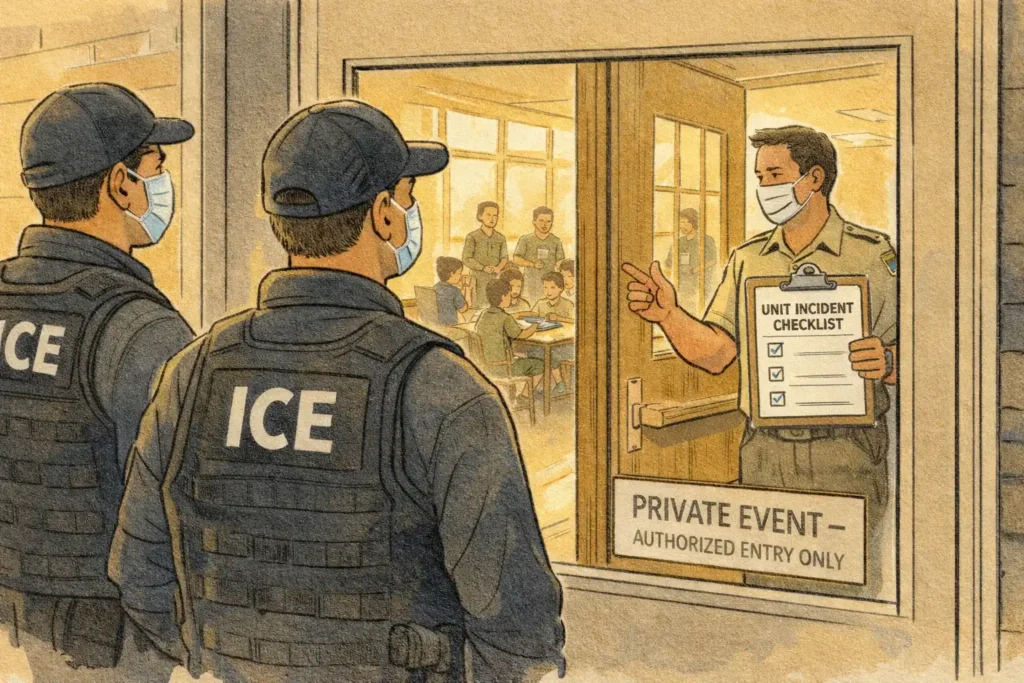
Over the last week, ICE agents have shown up at schools during the day and even entered daycares while kids were there. As a Cubmaster with a responsibility to keep Scouts safe, watching that unfold led me to a question I never thought I’d have to ask: What do I do if ICE shows up at one of my pack meetings?
As I’ve observed these operations in my own community, this stopped being a hypothetical.
And if you’re reading this thinking, “I never signed up for this,” I get it. Neither did I.
Here’s what I know for sure: Whether you support or oppose federal enforcement policy is between you and your conscience. But your job as a Cubmaster? That’s crystal clear. Keep your Scouts safe.
Here’s how I’ve been thinking through that.
A Note Before We Begin
I’m a volunteer Cubmaster in central Virginia, not an attorney or an employee of Scouting America. This post is not legal advice, and it is not official Scouting America policy. It’s my interpretation of existing Scouting America youth protection and incident reporting frameworks, combined with legal resources from immigrant rights organizations and what I’ve observed over the past week.
For legal questions, consult an attorney. For official guidance, contact your local council. What follows is practical, Scout-aligned thinking from one leader to another.
What Scouting America Already Tells Us
When I started researching this, I assumed Scouting America had issued guidance on law enforcement encounters at meetings. I searched national sites, council safety pages, the Guide to Safe Scouting, incident reporting frameworks, and recent policy updates through January 2026. Nothing. Zero councils have addressed this publicly.
That silence leaves a gap. But it doesn’t leave us directionless.
Youth Protection & Incident Reporting
Scouting America’s youth protection framework is built on clear principles: two-deep leadership, transparent programs open to parents, and rapid incident reporting. The “Barriers to Abuse” policy states that adult leaders share responsibility for the safety of all participants and must recognize, respond to, and report situations that put youth at risk.
An ICE encounter at a Cub Scout meeting fits that description. It’s an external event affecting youth safety that requires leader action, documentation, and notification to the council.
The Navigating Incidents guide specifies that units must notify the local council about the incident promptly and document who, what, when, where, and why. This structure applies to an ICE presence just as it would to an injury, a weather emergency, or any other significant disruption to program safety.
Here’s the key point: You are not required to facilitate immigration enforcement. But you are required to protect youth, notify families, and inform your council when something serious happens.
Refugees & Foreign Nationals Policy
Scouting America explicitly welcomes refugees and foreign nationals. The Supporting Refugees & Foreign Nationals guide makes clear that US citizenship is not required of youth or adult members. Youth who are refugees, international students, or children of immigrant families are entitled to full membership and advancement.
This policy clarifies that unit leaders don’t ask about, track, or report immigration status. It’s simply not part of our role.
If Federal Agents Appear at Your Meeting
If federal agents appear at or near your meeting, your response should align with Scouting’s existing safety and incident management principles. Here’s a framework built on what we already do.
1. Keep kids safe and calm
Your first priority is keeping your Scouts calm and supervised. If you can, keep the program running. Kids who are occupied with an activity are less likely to be scared or watching what’s happening outside. Two-deep leadership stays with them while one adult handles the door.
Do not let Scouts become witnesses, negotiators, or bystanders filming the encounter. Their job is to be kids doing Scout stuff. Your job is to make that possible.
Designate adult roles immediately: one or two leaders stay with the kids, one handles communication with agents, and one contacts parents and the council.
2. Designate one adult as the point person
Choose a calm, non-confrontational leader who is not personally at immigration risk to step outside or interact with agents. That person’s job is to ask threshold questions and set boundaries, not to cooperate beyond what’s legally required.
Simple script:
- “I’m a volunteer leader with a youth program. Are you here in connection with this event or these children?”
- “Am I personally being detained, or am I free to go back inside?”
3. Respect lawful authority, but assert basic boundaries
ICE agents can operate in public areas such as parking lots, lobbies, and sidewalks without a warrant. But if they want to enter a private meeting space, like a classroom, fellowship hall, or reserved room, they need a judicial warrant signed by a judge, not just an administrative ICE document.
- “Do you have a judicial warrant signed by a judge that allows you to enter this room?”
If they show a document, you or the building authority, such as a pastor, principal, or facility manager, can request to see it through a window or under the door. Check whether it’s signed by a judge and whether it lists the correct address and room.
If there is no valid judicial warrant:
- “This is a private youth program space, and I can’t let you in without a judicial warrant. I need to continue supervising the children.”
Immediately contact your chartered organization leadership and your council’s professional staff, such as your District Executive or Scout Executive.
4. Don’t volunteer information about families
You are not required to tell ICE whether specific individuals are present, share rosters, provide addresses, or discuss anyone’s immigration status. Guidance from communities facing high ICE activity notes that you have the right to remain silent about who is in the building.
Do not physically interfere with an arrest. That could create legal liability for you and the unit. But you also don’t need to facilitate enforcement by answering questions or pointing agents toward families.
5. Document and notify your council
Treat the encounter like any significant incident. Quietly note:
- Time and location
- Badge numbers or vehicle information, if visible
- What agents said and requested
- How the situation was resolved
- Which families were present or affected
Notify your council as soon as practicable. This is not optional. It’s part of Scouting’s incident reporting requirement. Your council needs to know so they can provide follow-up support, coordinate with the chartered organization, and escalate to risk management if necessary.
If you’re unable to reach your council immediately, or if the situation involves potential harm to youth, you can also contact the ScoutsFirst Helpline at 1-844-SCOUTS1 (1-844-726-8871) for guidance.
That’s the framework. Your pack’s situation might be different. Different chartered organization, different community, different families. Adapt this to what makes sense for you. The core principle stays the same: Keep kids safe, know your boundaries, document what happens, and notify your council.
What Leaders Can Do Before Anything Happens
Proactive preparation beats reactive scrambling. Here are simple steps you can take now.
Talk with your chartered organization
Your pack’s chartered organization, whether a church, school, or civic group, owns the facility relationship and sets policies for who can access meeting spaces. Sit down with your COR, pastor, or principal and ask:
- Are our meetings in public or private space?
- Who has the authority to grant or deny law enforcement access?
- What does the organization want unit leaders to do if agents appear?
Clarify this in writing so you’re not improvising under pressure.
A note for new leaders: This might feel overwhelming. Start with this one thing. Talk to your chartered organization about who controls building access. That’s most of the prep work right there.
Clarify “public vs. private” at your meeting place
Public areas, like lobbies, sanctuaries, and hallways, are generally accessible to law enforcement without a warrant. Private areas marked “staff only,” “authorized personnel,” or explicitly reserved rooms typically require a judicial warrant for entry.
If your meeting space is ambiguous, work with your chartered organization to post signage or establish a policy that clarifies boundaries.
Share calm, non-scary information with parents
Families need to know you’ve thought about this. You don’t need to alarm them. A short note in your next pack newsletter could say:
“As part of our commitment to youth safety, our pack leadership has reviewed policies for any situation that could affect program operations. We do not ask about or track immigration status. If law enforcement ever appears at a meeting, our priority is your child’s immediate safety, program continuity, and notifying you promptly.”
This signals competence and care without creating panic.
Train your leaders with a one-page checklist
Print or share a simple protocol with all registered adults:
- Keep kids inside and supervised.
- Designate one adult to interact with agents.
- Ask about a judicial warrant before allowing entry.
- Do not share personal information about families.
- Document what happened and notify the council immediately.
Role-play it once at a committee meeting so leaders know their assignments.
Should You Push Your Council for Guidance?
I think so. And if you’re thinking, “But I’m just a volunteer leader, not a policy expert,” that’s exactly why you should ask.
No Scouting America council has issued specific guidance on ICE encounters or immigration enforcement at meetings. That gap leaves volunteer leaders improvising in real time, which is exactly what youth protection policies are designed to prevent.
Your council already handles youth safety customization, incident follow-up, and risk management. A one-page law enforcement encounter protocol fits naturally alongside the Navigating Incidents guide and Barriers to Abuse training. It’s not a political statement. It’s operational risk management.
How to ask
Email your District Executive or Scout Executive with a concise, solution-oriented request. Here’s a template:
Subject: Request for Unit Guidance on Law Enforcement Encounters
Hi [DE name],
Given recent federal enforcement activity near schools and community spaces, I’m writing to request that [Council Name] develop a simple protocol for unit leaders on handling law enforcement encounters at meetings.
Scouting America’s refugee and foreign national inclusion policy makes clear that we welcome all youth regardless of citizenship status. Our incident reporting framework requires prompt notification to the council when significant events affect program safety. A brief guideline, modeled on our existing Youth Protection and Navigating Incidents resources, would help units respond calmly, protect youth, and fulfill our reporting responsibilities.
I’d be happy to draft a one-page checklist for committee review if that would be helpful. Please let me know how [Council Name] plans to support units on this issue.
Thank you,
[Your name, Pack/Troop number, role]
CC your chartered organization representative so they’re looped in.
Frame this as implementing existing policy under new stress, not creating something from scratch. Councils respond well to informed, solution-oriented leaders who bring practical tools.
How This Fits the Citizenship Story We Tell Scouts
When Scouts see their leaders stay calm, know their boundaries, and protect every family in the pack, that’s citizenship in action. Not a worksheet. Not a requirement. The real thing.
Scouting teaches citizenship through merit badges like Citizenship in the Community, Citizenship in the Nation, and Citizenship in Society, which has been required for Eagle since July 1, 2022. These badges ask Scouts to explore diversity, equity, and inclusion, and how institutions should treat people.
When we prepare for law enforcement encounters, we’re modeling practical civics. Scouts learn that:
- Adults know the rules and legal boundaries.
- Leaders stand calmly for youth safety, even under pressure.
- Every family deserves dignity and protection, regardless of status.
That lesson matters more than any merit badge pamphlet.
What’s Next
I don’t have all the answers. I’m a volunteer Cubmaster working through this just like you are. But I’d rather have a rough plan than no plan. And I’d rather we figure this out together than each of us improvising alone when it matters most.
If your council develops guidance, share it. If your chartered organization clarifies facility policies, document it. And if your pack ever navigates an actual encounter, report back so we can all learn.
I’ll keep this post updated as new information emerges. In the meantime, stay calm, stay informed, and keep your focus where it belongs: on the Scouts.
Resources
Scouting America Official Resources:
- Supporting Refugees & Foreign Nationals
- Navigating Incidents: Guide for Units
- Guide to Safe Scouting
- ScoutsFirst Helpline: 1-844-SCOUTS1 (1-844-726-8871)
Know Your Rights & Legal Resources:
- ACLU: What To Do If ICE Is At Your Door
- National Immigration Law Center: Know Your Rights
- Contact your state ACLU affiliate for local materials
- Contact local immigrant rights organizations for family legal support
For Your Council:
- Reach out to your District Executive or Scout Executive to request local guidance
- Share this post with your pack committee and chartered organization leadership
I’m a Cubmaster in central Virginia and run Glad Scout, a resource site for Scout leaders. I am not an attorney or an employee of Scouting America. This post is not legal advice or official policy. For legal questions, consult an attorney. For official guidance, contact your council.
What questions do you have? Drop them in the comments or email me directly. Let’s figure this out together.