
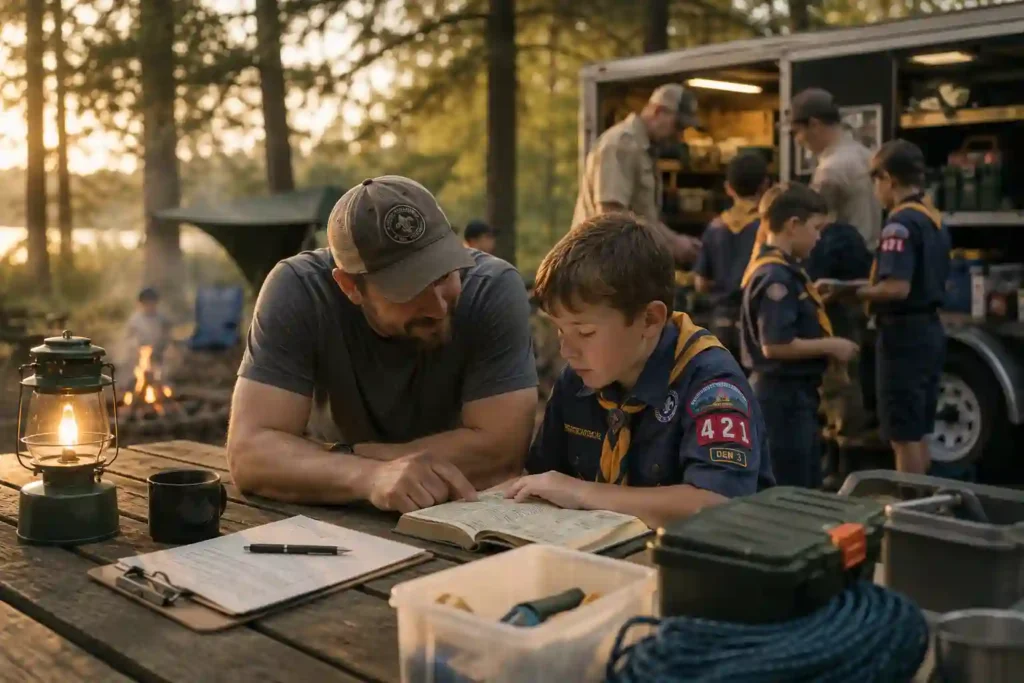
Cub Scouts can feel hard to read from the outside.
You see uniforms, camping trips, Pinewood Derby cars, signup forms, and words like “Pack” and “den,” and it seems like everyone else already understands how this whole thing works.
But most parents are trying to answer a much simpler question:
Can our family realistically do this? Not theoretically. Actual life. School schedules. Sports. Work. Dinner. Exhausted weeknights. Kids melting down because somebody touched the wrong granola bar.
Most people are not looking for another complicated activity to manage. They’re looking for something worthwhile that still feels doable.
Here’s what most families want to know before they sign up:
- Cub Scouts works around real family schedules. Perfect attendance is not expected.
- Parent volunteering starts small. Most people begin with snacks and chairs.
- Camping is optional, and your Pack will help you prepare when you’re ready.
- Kids of all personalities find their place. There is no one mold.
- You do not need to understand everything before your first meeting.
What Is Cub Scouts Really Like?
At its core, Cub Scouts is kids doing things together.
They build things. Race Pinewood Derby cars. Go on hikes. Learn outdoor skills. Play games. Sit around campfires. Make dumb jokes. Get dirty. Forget water bottles. Come home tired.
Some meetings are organized. Some are loud in the way elementary school activities tend to be.
Mostly, it’s kids getting older together while trying things they probably would not try on their own.
For parents, the experience often becomes something slightly different than expected.
Cub Scouts gives families recurring reasons to spend time together during a stage when kids still want that. That sounds obvious until your child gets older and you realize how quickly schedules and independence start pulling everyone in different directions.
A lot of Scout parents remember the small stuff more than the big events:
- sanding a Pinewood Derby car at the kitchen table
- trying to put up a tent before dark
- hearing the same campfire skit repeated by six different kids
- watching your child suddenly volunteer to help with something without being asked
It also works for a wider range of kids than people sometimes expect.
The highly competitive kid who wants to earn every badge can thrive there. So can the kid who spends the first three meetings barely saying anything. Some kids love leading songs and games. Some like hiking. Some become obsessed with knots or Pinewood Derby strategy. Some just like having a group where they know people.
Kids are not competing for limited playing time or trying to fit one personality mold. Different kids usually find their lane.
How Much Time Does Cub Scouts Take?
Most Cub Scout Packs (the local group your child would join, usually 20 to 60 families from your area) have:
- smaller den meetings with kids in the same grade
- larger Pack meetings with all the families together
- occasional weekend events
- camping opportunities a few times a year
Once families see the rhythm, Cub Scouts usually feels less intimidating than the signup table made it look.
And despite what new parents sometimes assume, perfect attendance is not the expectation.
Scout families are juggling the same things everybody else is. Soccer, baseball, dance, church, birthday parties, family travel, overloaded weeks. People miss meetings. Rain ruins campouts. Half the Pack gets sick the week before Pinewood Derby.
Most Packs are used to families balancing multiple commitments.
Do Parents Have to Volunteer?
Most Cub Scout Packs ask families to help in small ways, but that does not automatically mean becoming a leader or taking on a major role.
Packs need parent help because Packs are run by parents. But most people start with ordinary things:
- bringing snacks
- helping set up chairs
- checking families in at an event
- supervising a station during a Pack meeting
Some parents eventually take bigger roles. Some don’t. Most figure it out as they go.
New parents tend to assume everybody else already knows what they’re doing. Mostly they just joined earlier.
Do You Have to Camp?
Camping is not required. But it is one of the parts kids remember longest.
Most Packs participate in camporees (organized camping events where multiple Packs camp together) or host their own campout at least once a year, often more.
If you have never camped before, that is okay. Before each campout, leaders share a gear list, explain what the site is actually like (yes, including whether there are flush toilets), and set expectations so nobody shows up surprised. The adults running the trip complete training specifically for this, including BALOO (Basic Adult Leader Outdoor Orientation) and required hazardous weather training.
Your leaders will help make sure your family shows up ready. The one thing most Scouts still manage to forget? Asking for screen time.
Will My Child Fit In?
This is probably the biggest unspoken question parents have.
What if my child is shy? What if they are not athletic? What if they struggle to find their place in other groups?
Cub Scouts tends to work well because there are multiple ways for kids to participate and contribute. A den (the smaller group of kids your child meets with regularly, usually 6 to 10 kids from the same grade) starts feeling less like a roster and more like a group of kids growing up alongside one another.
Some kids jump in immediately. Others spend weeks orbiting the edge before deciding they’re comfortable. You see both every year.
So Is It Worth Trying?
For most families, yes.
Not because it’s perfectly organized or friction-free. Nothing involving elementary-aged children ever is.
But here is what most families find once they’re inside:
- Meetings fit around real life. You will miss some. That is fine.
- Volunteering grows at your pace. Nobody hands you a clipboard on day one.
- Camping gets easier every time. Your Pack will not leave you guessing.
- Your child will find their place. It just might take a few meetings.
The best next step is finding a Pack in your area and asking if you can visit a meeting before committing. Most Packs will say yes.