

The Family Troop model will be available nationwide starting December 15, 2025. After a year-long pilot in 174 councils, Scouts BSA has decided to make it a permanent choice, alongside traditional boy and girl troops. If you’re a Scoutmaster and want to know what this means for your unit, here’s what you need to know and how to decide if it’s right for you.
What’s Changing (and What’s Not)
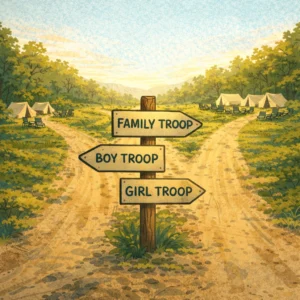
Beginning December 15, chartered organizations can choose to run a single Scouts BSA troop for both boys and girls, now officially called a “Family Troop.” Family Troops do not replace single-gender troops; they simply add a third option.
The pilot program ran from September 2024 to July 2025 and showed strong results. Troops in the pilot saw membership growth, improved program delivery, high satisfaction among youth and families, and greater efficiency. Scouters found it helpful in small rural communities where separate troops were not sustainable, and in suburban areas where linked troops were overwhelming volunteers.
The key point is that this is optional. Your chartered organization must approve any conversion. No troop is required to change. Many troops will remain single-gender, and that is completely fine.
The 3-Minute Assessment: Is This for Your Troop?
Before you dive into implementation guides or talk to your committee, answer these three questions honestly:
1. Does your chartered organization support exploring this?
Stop here if the answer is no.
Family Troop conversions require charter org approval. This is not a Scoutmaster or Troop committee-only decision. If your Chartered Organization Representative or organizational leadership has strong preferences for single-gender Scouting, respect that. This option exists if circumstances change down the road.
2. Are you currently facing one of these challenges?
- Running linked boy and girl troops with duplicate meetings, budgets, and administrative work
- Enrollment is too low in one or both troops to sustain separate units in the long term.
- Families explicitly ask why you don’t offer co-ed Scouting.
- Youth numbers are declining, and consolidation could stabilize your unit.
If none of these challenges apply to you, a Family Troop is probably not needed. If one or more of them sound familiar, keep reading.
3. Can your adult leadership team commit to unified programming?
Family Troops work when you run one program for all Scouts—not separate “boy activities” and “girl activities” under one roof. Pilot troops learned the hard way that splitting programming fragments creates two troops sharing a meeting space rather than a single collaborative unit.
You’ll also need active adult supervision (especially during downtime), clear behavioral expectations set by your Patrol Leaders’ Council, and a willingness to let youth self-organize patrols naturally. Safety protocols remain unchanged: separate sleeping and bathing facilities are still required under Youth Protection and Barriers to Abuse guidelines.
If you answered yes to all three questions, a Family Troop might make sense. Keep reading for next steps.
If you answered no to any of these questions, that is your answer. Instead of becoming a Family Troop, focus on making your single-gender troop stronger. We will discuss alternatives at the end of this article.
When Family Troops Make the Most Sense
Based on pilot program data, here are the three scenarios where Family Troop conversions solve real problems:
Scenario 1: You’re Running Linked Troops, and It’s Exhausting
If you are running Troop 123 for boys and Troop 321 for girls, each with separate Scoutmasters, meetings, committee work, and double the administrative tasks, combining into one Family Troop can significantly reduce your workload.
You will have one Scoutmaster instead of two, one Senior Patrol Leader, a unified patrol system, and a single calendar. The time volunteers spend on duplicate administration can go back to delivering the program. Leaders from the pilot program said this was the most significant relief.
Scenario 2: Your Small Community Can’t Sustain Separate Troops
If you are in a rural area or small town with 8 to 12 Scouts split between boy and girl troops, it can be hard to keep both groups going. A Family Troop lets you combine everyone into one sustainable unit, making it easier to have enough Scouts for campouts, service projects, and leadership opportunities.
This was the main reason for the pilot program, and it is where Scouters saw the most success.
Scenario 3: Families Are Asking for Co-Ed Scouting
Some families genuinely prefer a co-ed program where siblings can be in the same troop, meetings are combined, and Scouts learn to lead together. If you are hearing this from several families and your chartered organization is open to it, a Family Troop lets you serve these families while still supporting those who want single-gender options. Those families can join nearby troops.
When to Stay Single-Gender (And Feel Good About It)
Family Troops aren’t the answer for every situation. Here’s when sticking with your current model makes more sense:
Your troop is thriving: If enrollment is strong, families are happy, and you are meeting your community’s needs, there is no reason to change. Don’t fix what isn’t broken.
Your charter org prefers single-gender Scouting: Many chartered organizations have philosophical or practical reasons for maintaining boy-only or girl-only troops. That’s a legitimate choice, and single-gender troops remain fully supported by Scouting America.
You don’t have the structural problems Family Troops solves: If you’re not running exhausting linked troops and your enrollment is sustainable, this option doesn’t add value.
Keep in mind that most troops will stay single-gender. Family Troops are meant for specific situations, not as a universal requirement.
Your Next Steps
If You’re Seriously Considering Conversion:
This week:
- Talk informally with your Committee Chair and Chartered Organization Representative to gauge their openness.
- Review your enrollment trends and gather data on why conversion might help.
- Connect with other Scoutmasters at roundtable who’ve been thinking about this.
After December 15:
- Look for new resources released by Scouting America for Family Troops.
- Present the option formally to your chartered organization for approval.
- Survey current Scouts and families to gauge interest and concerns
- Reach out to Scoutmasters of a pilot troop in your area for firsthand advice.
If approved, plan for January:
- Begin a structured 60-day implementation timeline.
- Develop your troop’s code of conduct and behavioral expectations.
- Create a communication plan for families.
If You’re Staying Single-Gender:
- Stay informed about Family Troops in case your circumstances change.
- Focus on strengthening recruitment and retention in your current model.
- Consider collaboration with nearby troops for joint events if enrollment is tight.
If You’re Unsure:
Take your time. If you need more time, more information, more resources to make an informed decision—take it. Wait for new resources to be published, talk to other leaders at roundtable, and connect with pilot troop Scoutmasters before you decide.
The Family Troop Option Is About Flexibility, Not Pressure
The December 15 launch represents an expansion of choice, not a mandate for change. Whether you run a thriving single-gender troop, manage exhausting linked troops, or serve a small community struggling to sustain separate units, you now have options that fit your situation.
The most important takeaway is this: make decisions based on your troop’s actual needs, not on assumptions about what Scouting America expects. Single-gender troops remain the foundation of Scouts BSA, and they will continue to serve millions of young people well. Family Troops simply provide an additional tool for chartered organizations facing specific challenges.
If you are a Scoutmaster wondering whether this applies to you, trust your instincts. You know your community, your families, and your chartered organization better than any national program guide. Use the three-question assessment in this article as a starting point, but let your local reality guide your decision.
The best choice for your troop is the one that helps you deliver a strong Scouting program to the youth you serve. Everything else is secondary.